
Work
About
Contact
What Taking a Squarespace Website Live Taught Me About Design, Technology and Business
August 21, 2026
I started with a logo and a very real client. I ended with a live website and a few unexpected lessons about art direction, ownership, AI and becoming a business owner.
A quick website revamp for a lawyer friend became a rather important milestone in my own journey from working within one part of the design process to owning the whole thing.
There is something wonderfully dramatic about pressing “Publish” on a website.
Logically, I know it is a button.
Emotionally, however, it feels more like: Well, this now exists on the internet, and everyone can see it.
Recently, I designed and launched the new website for my friend and client, Nikita, founder of Shanik Consultants, a boutique legal and corporate advisory practice in the UAE.
It was a quick revamp. There was no elaborate six-month design programme, no enormous cross-functional team and definitely no war room.
Nikita came to me with a logo, a legal practice and a clear sense of the kind of advisor she wanted to be. My job was to turn those ingredients into a digital presence that felt like her.
Simple, right?
Not quite.
The project ended up teaching me a few things about designing for a real person, creating an art direction from almost zero, taking ownership beyond the Figma file and perhaps most importantly; understanding what it means to slowly become a serious business owner.
From one part of the process to the whole thing
I come from the world of large organisations, including Accenture, where the design process is often clearly divided.
There are researchers. UX designers. UI designers. Developers. Project managers. Content teams. Business stakeholders. And, occasionally, several meetings to prepare for another meeting.
As a UX designer, I was deeply involved in understanding problems and designing experiences. But I was not usually the person building the final website, connecting the domain, checking the mobile version and making the whole thing live.
My responsibility existed within a larger system.
This project was different.
There was no moment where I could hand over a polished design and say, “Development can take it from here.”
I was development.
I was also research, visual design, content support, art direction, quality assurance and the person staring at the domain settings wondering whether touching one innocent-looking option might bring down the entire internet.
It did not, thankfully.
But this was the first big learning: owning the complete outcome feels very different from owning one stage of the process.
Learning one:
Designing the person before designing the pages
Nikita is a lawyer, but “lawyer” is not a brand personality.
Before thinking about page layouts, fonts or images, I needed to understand who she was as an advisor.
What did she want her clients to feel when they encountered her business?
What made her approach different?
Who did she want to work with?
Should the website feel traditional and institutional? Modern and ambitious? Warm and personal? Serious without becoming intimidating?
These questions shaped the website far more than any Squarespace template could.
The final direction needed to communicate credibility, precision and legal expertise; but it also needed to feel commercially aware, contemporary and human. Nikita’s work is not simply about explaining the law. It is about helping businesses make informed decisions, manage risk and move forward with confidence.
That distinction became central to the website.
This was not a full brand identity exercise because Nikita already had a logo. I would describe my role as developing the visual identity, digital expression and art direction around the existing brand.
And yes, at some point, I would still love to do the complete brand identity exercise with her. Designers rarely believe a project is truly finished. We simply develop increasingly ambitious ideas for version two.
Learning two:
Art direction is really a series of decisions about personality
I had never formally owned art direction in this way before.
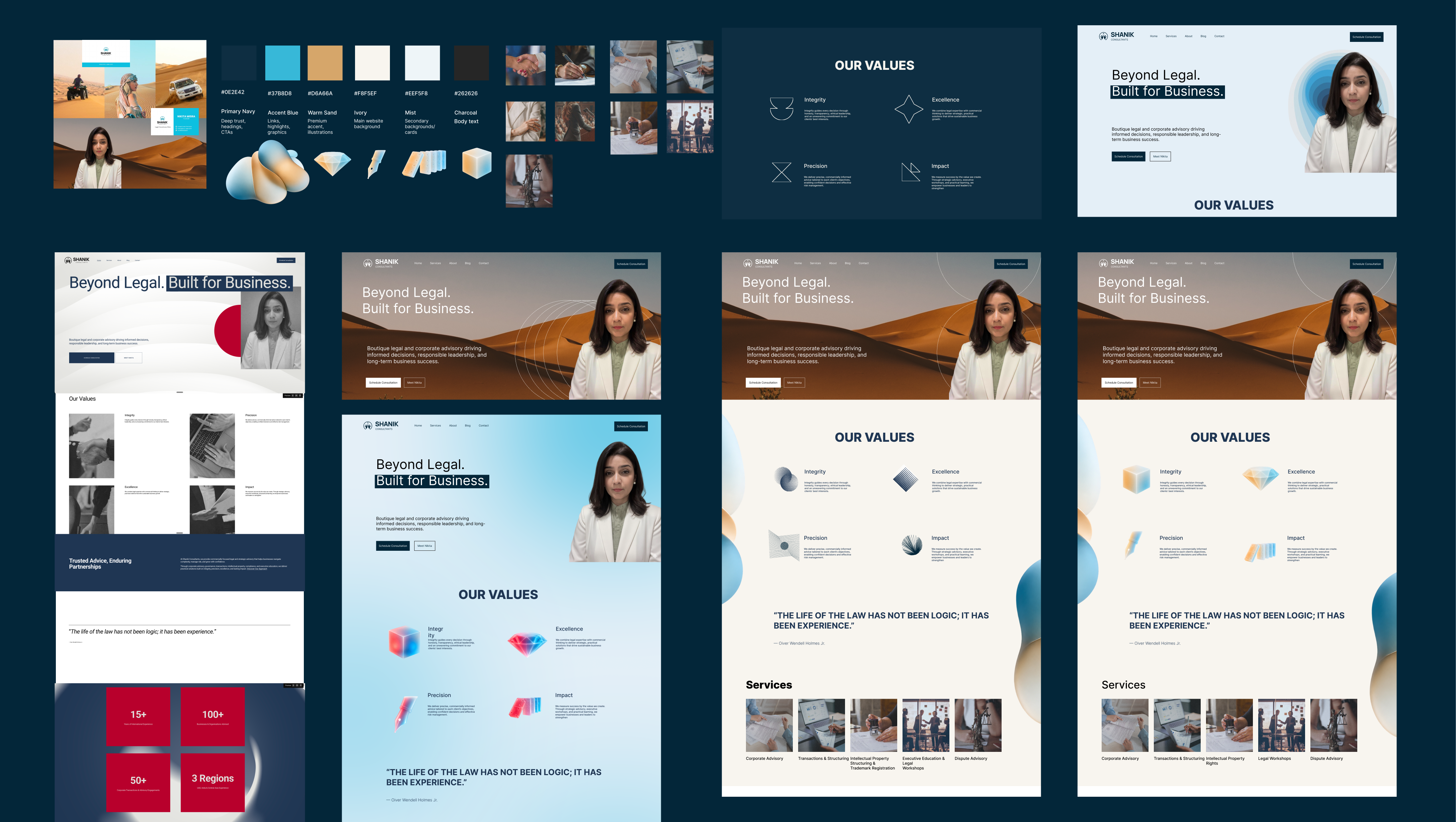
I began creating mood boards and exploring typography, colour, composition, imagery and overall visual language.
What kinds of images could represent a modern legal advisor without falling into the usual collection of gavels, handshakes and suspiciously enthusiastic people pointing at contracts?
What fonts could feel authoritative without making the website look as though it had been written in 1847?
How could we create something polished and premium while keeping it approachable?
Art direction can look glamorous once it is assembled into a beautiful mood board. In practice, it is a long sequence of small decisions.
This image, but not that one.
This blue, but slightly deeper.
This typeface has presence. That one appears to be shouting.
This composition feels confident. That one feels like a bank.
Each decision helped translate Nikita’s personality and positioning into something visual. It reminded me that a website should not simply contain information about a business. It should create a feeling about that business.
That feeling starts before anyone reads a single paragraph.
Learning three:
Taking a website live is a design skill too
The second or technically third, depending on how we are counting major learning was taking the Squarespace website live.
This may sound very basic to someone who launches websites every week.
For me, it was a genuine milestone.
Until this project, my experience with template-based websites mostly involved helping my husband make design updates to the website for his perfume business. The structure already existed. I was improving and adjusting it.
Here, I was starting with a much emptier canvas and taking responsibility for the complete journey.
I had to understand the platform, work within its possibilities and limitations, build the pages, make the experience responsive, connect everything and finally publish it.
The interesting part was not merely learning where Squarespace keeps all its settings; although that itself is occasionally an archaeological exercise.
The real learning was understanding how design decisions behave once they leave the controlled environment of a design tool.
Headlines wrap differently. Images crop themselves with surprising confidence. Mobile screens expose every questionable spacing decision you have ever made. A section that looks perfectly balanced on your laptop may develop an entirely different personality on another screen.
Taking a website live made me think beyond the static composition. It made me responsible for the experience as something real, responsive and usable.
And pressing that final button was ridiculously satisfying.
The inevitable question: Are platforms like Squarespace already obsolete?
We now have Codex, Claude Code and a growing collection of AI tools that can generate surprisingly beautiful websites from a prompt.
So it is fair to ask: are platforms such as Squarespace and Wix or even managed WordPress setups becoming obsolete?
My answer, at least today, is no.
Could I create a custom-coded website with AI? Absolutely.
Could that website be more flexible, technically sophisticated and visually unique? Quite possibly.
But the best solution is not automatically the one with the most advanced technology.
It is the one the client can confidently own.
Nikita does not want to connect an MCP server, manage a repository or have a thoughtful conversation with an AI coding assistant every time she needs to correct a sentence.
She wants to log in.
She wants to edit some text.
She wants to publish an article when she has something useful to say.
She wants to run her legal advisory business without accidentally becoming the head of a small digital department.
For a solopreneur, that independence matters.
Squarespace gives her a packaged environment she can understand and operate. The website may have been designed by me, but it does not need to remain permanently dependent on me.
That is not a compromise. That is part of the user experience.
Democracy in technology is not only about what we can create
AI is making digital creation dramatically faster. It is reducing the technical barrier between an idea and a functioning product, which I find genuinely exciting.
But access is not just the ability to generate something.
It is also the ability to maintain it, understand it and feel in control of it after the person who created it has left the room.
Template-based platforms are still valuable because they make digital ownership possible for people without a technology team. They provide structure, familiarity and support. They allow a lawyer, consultant, artist or small-business owner to manage a credible digital presence alongside the work they actually built their business to do.
Perhaps AI will eventually make custom websites equally simple to maintain. We may reach a point where editing a coded website feels as ordinary as editing a paragraph in Squarespace.
But we are not completely there yet.
For now, the more interesting question is not:
Can AI build this?
It is:
Who needs to own this after it has been built?
A small website and a rather large personal milestone
It has been about a year since I left my full-time job.
During that time, I have been moving through a slightly messy but exciting evolution: from full-time designer to independent contributor, freelancer, technology specialist and business owner in the making.
I am still figuring out what the final version of that identity looks like.
This project did not involve the largest team, the longest timeline or the most complex technology I have ever encountered. But it required something I had not always been asked to do in my previous roles: take complete responsibility for turning an idea into a live outcome.
I had to understand the client, interpret her personality, create the visual world, work within technological constraints and deliver something she could continue using without me.
That feels important.
Because perhaps becoming a business owner is not one dramatic transformation.
Perhaps it happens through a collection of smaller moments.
The first client who trusts you with an unfinished idea.
The first time you make the important decisions yourself.
The first time you move beyond your official discipline because the outcome needs you to.
And, of course, the first time you press “Publish,” refresh the page and realise:
Oh. I actually made that live.

Connect with us to explore your project's potential.



What Taking a Squarespace Website Live Taught Me About Design, Technology and Business
August 21, 2026
I started with a logo and a very real client. I ended with a live website and a few unexpected lessons about art direction, ownership, AI and becoming a business owner.
A quick website revamp for a lawyer friend became a rather important milestone in my own journey from working within one part of the design process to owning the whole thing.
There is something wonderfully dramatic about pressing “Publish” on a website.
Logically, I know it is a button.
Emotionally, however, it feels more like: Well, this now exists on the internet, and everyone can see it.
Recently, I designed and launched the new website for my friend and client, Nikita, founder of Shanik Consultants, a boutique legal and corporate advisory practice in the UAE.
It was a quick revamp. There was no elaborate six-month design programme, no enormous cross-functional team and definitely no war room.
Nikita came to me with a logo, a legal practice and a clear sense of the kind of advisor she wanted to be. My job was to turn those ingredients into a digital presence that felt like her.
Simple, right?
Not quite.
The project ended up teaching me a few things about designing for a real person, creating an art direction from almost zero, taking ownership beyond the Figma file and perhaps most importantly; understanding what it means to slowly become a serious business owner.
From one part of the process to the whole thing
I come from the world of large organisations, including Accenture, where the design process is often clearly divided.
There are researchers. UX designers. UI designers. Developers. Project managers. Content teams. Business stakeholders. And, occasionally, several meetings to prepare for another meeting.
As a UX designer, I was deeply involved in understanding problems and designing experiences. But I was not usually the person building the final website, connecting the domain, checking the mobile version and making the whole thing live.
My responsibility existed within a larger system.
This project was different.
There was no moment where I could hand over a polished design and say, “Development can take it from here.”
I was development.
I was also research, visual design, content support, art direction, quality assurance and the person staring at the domain settings wondering whether touching one innocent-looking option might bring down the entire internet.
It did not, thankfully.
But this was the first big learning: owning the complete outcome feels very different from owning one stage of the process.
Learning one:
Designing the person before designing the pages
Nikita is a lawyer, but “lawyer” is not a brand personality.
Before thinking about page layouts, fonts or images, I needed to understand who she was as an advisor.
What did she want her clients to feel when they encountered her business?
What made her approach different?
Who did she want to work with?
Should the website feel traditional and institutional? Modern and ambitious? Warm and personal? Serious without becoming intimidating?
These questions shaped the website far more than any Squarespace template could.
The final direction needed to communicate credibility, precision and legal expertise; but it also needed to feel commercially aware, contemporary and human. Nikita’s work is not simply about explaining the law. It is about helping businesses make informed decisions, manage risk and move forward with confidence.
That distinction became central to the website.
This was not a full brand identity exercise because Nikita already had a logo. I would describe my role as developing the visual identity, digital expression and art direction around the existing brand.
And yes, at some point, I would still love to do the complete brand identity exercise with her. Designers rarely believe a project is truly finished. We simply develop increasingly ambitious ideas for version two.
Learning two:
Art direction is really a series of decisions about personality
I had never formally owned art direction in this way before.
I began creating mood boards and exploring typography, colour, composition, imagery and overall visual language.
What kinds of images could represent a modern legal advisor without falling into the usual collection of gavels, handshakes and suspiciously enthusiastic people pointing at contracts?
What fonts could feel authoritative without making the website look as though it had been written in 1847?
How could we create something polished and premium while keeping it approachable?
Art direction can look glamorous once it is assembled into a beautiful mood board. In practice, it is a long sequence of small decisions.
This image, but not that one.
This blue, but slightly deeper.
This typeface has presence. That one appears to be shouting.
This composition feels confident. That one feels like a bank.
Each decision helped translate Nikita’s personality and positioning into something visual. It reminded me that a website should not simply contain information about a business. It should create a feeling about that business.
That feeling starts before anyone reads a single paragraph.
Learning three:
Taking a website live is a design skill too
The second or technically third, depending on how we are counting major learning was taking the Squarespace website live.
This may sound very basic to someone who launches websites every week.
For me, it was a genuine milestone.
Until this project, my experience with template-based websites mostly involved helping my husband make design updates to the website for his perfume business. The structure already existed. I was improving and adjusting it.
Here, I was starting with a much emptier canvas and taking responsibility for the complete journey.
I had to understand the platform, work within its possibilities and limitations, build the pages, make the experience responsive, connect everything and finally publish it.
The interesting part was not merely learning where Squarespace keeps all its settings; although that itself is occasionally an archaeological exercise.
The real learning was understanding how design decisions behave once they leave the controlled environment of a design tool.
Headlines wrap differently. Images crop themselves with surprising confidence. Mobile screens expose every questionable spacing decision you have ever made. A section that looks perfectly balanced on your laptop may develop an entirely different personality on another screen.
Taking a website live made me think beyond the static composition. It made me responsible for the experience as something real, responsive and usable.
And pressing that final button was ridiculously satisfying.
The inevitable question: Are platforms like Squarespace already obsolete?
We now have Codex, Claude Code and a growing collection of AI tools that can generate surprisingly beautiful websites from a prompt.
So it is fair to ask: are platforms such as Squarespace and Wix or even managed WordPress setups becoming obsolete?
My answer, at least today, is no.
Could I create a custom-coded website with AI? Absolutely.
Could that website be more flexible, technically sophisticated and visually unique? Quite possibly.
But the best solution is not automatically the one with the most advanced technology.
It is the one the client can confidently own.
Nikita does not want to connect an MCP server, manage a repository or have a thoughtful conversation with an AI coding assistant every time she needs to correct a sentence.
She wants to log in.
She wants to edit some text.
She wants to publish an article when she has something useful to say.
She wants to run her legal advisory business without accidentally becoming the head of a small digital department.
For a solopreneur, that independence matters.
Squarespace gives her a packaged environment she can understand and operate. The website may have been designed by me, but it does not need to remain permanently dependent on me.
That is not a compromise. That is part of the user experience.
Democracy in technology is not only about what we can create
AI is making digital creation dramatically faster. It is reducing the technical barrier between an idea and a functioning product, which I find genuinely exciting.
But access is not just the ability to generate something.
It is also the ability to maintain it, understand it and feel in control of it after the person who created it has left the room.
Template-based platforms are still valuable because they make digital ownership possible for people without a technology team. They provide structure, familiarity and support. They allow a lawyer, consultant, artist or small-business owner to manage a credible digital presence alongside the work they actually built their business to do.
Perhaps AI will eventually make custom websites equally simple to maintain. We may reach a point where editing a coded website feels as ordinary as editing a paragraph in Squarespace.
But we are not completely there yet.
For now, the more interesting question is not:
Can AI build this?
It is:
Who needs to own this after it has been built?
A small website and a rather large personal milestone
It has been about a year since I left my full-time job.
During that time, I have been moving through a slightly messy but exciting evolution: from full-time designer to independent contributor, freelancer, technology specialist and business owner in the making.
I am still figuring out what the final version of that identity looks like.
This project did not involve the largest team, the longest timeline or the most complex technology I have ever encountered. But it required something I had not always been asked to do in my previous roles: take complete responsibility for turning an idea into a live outcome.
I had to understand the client, interpret her personality, create the visual world, work within technological constraints and deliver something she could continue using without me.
That feels important.
Because perhaps becoming a business owner is not one dramatic transformation.
Perhaps it happens through a collection of smaller moments.
The first client who trusts you with an unfinished idea.
The first time you make the important decisions yourself.
The first time you move beyond your official discipline because the outcome needs you to.
And, of course, the first time you press “Publish,” refresh the page and realise:
Oh. I actually made that live.

Connect with us to explore your project's potential.


What Taking a Squarespace Website Live Taught Me About Design, Technology and Business
August 21, 2026
I started with a logo and a very real client. I ended with a live website and a few unexpected lessons about art direction, ownership, AI and becoming a business owner.
A quick website revamp for a lawyer friend became a rather important milestone in my own journey from working within one part of the design process to owning the whole thing.
There is something wonderfully dramatic about pressing “Publish” on a website.
Logically, I know it is a button.
Emotionally, however, it feels more like: Well, this now exists on the internet, and everyone can see it.
Recently, I designed and launched the new website for my friend and client, Nikita, founder of Shanik Consultants, a boutique legal and corporate advisory practice in the UAE.
It was a quick revamp. There was no elaborate six-month design programme, no enormous cross-functional team and definitely no war room.
Nikita came to me with a logo, a legal practice and a clear sense of the kind of advisor she wanted to be. My job was to turn those ingredients into a digital presence that felt like her.
Simple, right?
Not quite.
The project ended up teaching me a few things about designing for a real person, creating an art direction from almost zero, taking ownership beyond the Figma file and perhaps most importantly; understanding what it means to slowly become a serious business owner.
From one part of the process to the whole thing
I come from the world of large organisations, including Accenture, where the design process is often clearly divided.
There are researchers. UX designers. UI designers. Developers. Project managers. Content teams. Business stakeholders. And, occasionally, several meetings to prepare for another meeting.
As a UX designer, I was deeply involved in understanding problems and designing experiences. But I was not usually the person building the final website, connecting the domain, checking the mobile version and making the whole thing live.
My responsibility existed within a larger system.
This project was different.
There was no moment where I could hand over a polished design and say, “Development can take it from here.”
I was development.
I was also research, visual design, content support, art direction, quality assurance and the person staring at the domain settings wondering whether touching one innocent-looking option might bring down the entire internet.
It did not, thankfully.
But this was the first big learning: owning the complete outcome feels very different from owning one stage of the process.
Learning one:
Designing the person before designing the pages
Nikita is a lawyer, but “lawyer” is not a brand personality.
Before thinking about page layouts, fonts or images, I needed to understand who she was as an advisor.
What did she want her clients to feel when they encountered her business?
What made her approach different?
Who did she want to work with?
Should the website feel traditional and institutional? Modern and ambitious? Warm and personal? Serious without becoming intimidating?
These questions shaped the website far more than any Squarespace template could.
The final direction needed to communicate credibility, precision and legal expertise; but it also needed to feel commercially aware, contemporary and human. Nikita’s work is not simply about explaining the law. It is about helping businesses make informed decisions, manage risk and move forward with confidence.
That distinction became central to the website.
This was not a full brand identity exercise because Nikita already had a logo. I would describe my role as developing the visual identity, digital expression and art direction around the existing brand.
And yes, at some point, I would still love to do the complete brand identity exercise with her. Designers rarely believe a project is truly finished. We simply develop increasingly ambitious ideas for version two.
Learning two:
Art direction is really a series of decisions about personality
I had never formally owned art direction in this way before.
I began creating mood boards and exploring typography, colour, composition, imagery and overall visual language.
What kinds of images could represent a modern legal advisor without falling into the usual collection of gavels, handshakes and suspiciously enthusiastic people pointing at contracts?
What fonts could feel authoritative without making the website look as though it had been written in 1847?
How could we create something polished and premium while keeping it approachable?
Art direction can look glamorous once it is assembled into a beautiful mood board. In practice, it is a long sequence of small decisions.
This image, but not that one.
This blue, but slightly deeper.
This typeface has presence. That one appears to be shouting.
This composition feels confident. That one feels like a bank.
Each decision helped translate Nikita’s personality and positioning into something visual. It reminded me that a website should not simply contain information about a business. It should create a feeling about that business.
That feeling starts before anyone reads a single paragraph.
Learning three:
Taking a website live is a design skill too
The second or technically third, depending on how we are counting major learning was taking the Squarespace website live.
This may sound very basic to someone who launches websites every week.
For me, it was a genuine milestone.
Until this project, my experience with template-based websites mostly involved helping my husband make design updates to the website for his perfume business. The structure already existed. I was improving and adjusting it.
Here, I was starting with a much emptier canvas and taking responsibility for the complete journey.
I had to understand the platform, work within its possibilities and limitations, build the pages, make the experience responsive, connect everything and finally publish it.
The interesting part was not merely learning where Squarespace keeps all its settings; although that itself is occasionally an archaeological exercise.
The real learning was understanding how design decisions behave once they leave the controlled environment of a design tool.
Headlines wrap differently. Images crop themselves with surprising confidence. Mobile screens expose every questionable spacing decision you have ever made. A section that looks perfectly balanced on your laptop may develop an entirely different personality on another screen.
Taking a website live made me think beyond the static composition. It made me responsible for the experience as something real, responsive and usable.
And pressing that final button was ridiculously satisfying.
The inevitable question: Are platforms like Squarespace already obsolete?
We now have Codex, Claude Code and a growing collection of AI tools that can generate surprisingly beautiful websites from a prompt.
So it is fair to ask: are platforms such as Squarespace and Wix or even managed WordPress setups becoming obsolete?
My answer, at least today, is no.
Could I create a custom-coded website with AI? Absolutely.
Could that website be more flexible, technically sophisticated and visually unique? Quite possibly.
But the best solution is not automatically the one with the most advanced technology.
It is the one the client can confidently own.
Nikita does not want to connect an MCP server, manage a repository or have a thoughtful conversation with an AI coding assistant every time she needs to correct a sentence.
She wants to log in.
She wants to edit some text.
She wants to publish an article when she has something useful to say.
She wants to run her legal advisory business without accidentally becoming the head of a small digital department.
For a solopreneur, that independence matters.
Squarespace gives her a packaged environment she can understand and operate. The website may have been designed by me, but it does not need to remain permanently dependent on me.
That is not a compromise. That is part of the user experience.
Democracy in technology is not only about what we can create
AI is making digital creation dramatically faster. It is reducing the technical barrier between an idea and a functioning product, which I find genuinely exciting.
But access is not just the ability to generate something.
It is also the ability to maintain it, understand it and feel in control of it after the person who created it has left the room.
Template-based platforms are still valuable because they make digital ownership possible for people without a technology team. They provide structure, familiarity and support. They allow a lawyer, consultant, artist or small-business owner to manage a credible digital presence alongside the work they actually built their business to do.
Perhaps AI will eventually make custom websites equally simple to maintain. We may reach a point where editing a coded website feels as ordinary as editing a paragraph in Squarespace.
But we are not completely there yet.
For now, the more interesting question is not:
Can AI build this?
It is:
Who needs to own this after it has been built?
A small website and a rather large personal milestone
It has been about a year since I left my full-time job.
During that time, I have been moving through a slightly messy but exciting evolution: from full-time designer to independent contributor, freelancer, technology specialist and business owner in the making.
I am still figuring out what the final version of that identity looks like.
This project did not involve the largest team, the longest timeline or the most complex technology I have ever encountered. But it required something I had not always been asked to do in my previous roles: take complete responsibility for turning an idea into a live outcome.
I had to understand the client, interpret her personality, create the visual world, work within technological constraints and deliver something she could continue using without me.
That feels important.
Because perhaps becoming a business owner is not one dramatic transformation.
Perhaps it happens through a collection of smaller moments.
The first client who trusts you with an unfinished idea.
The first time you make the important decisions yourself.
The first time you move beyond your official discipline because the outcome needs you to.
And, of course, the first time you press “Publish,” refresh the page and realise:
Oh. I actually made that live.

Connect with us to explore your project's potential.

