
Work
About
Contact
What If Your Real Estate Business Could Respond to Every Lead, Instantly?
September 8, 2026
How we helped Deja Vu Real Estate bring Instagram, WhatsApp and website enquiries into one seamless AI-powered platform, enabling faster responses, smarter lead management and effortless human handovers.
In real estate, a lead rarely waits.
Someone sees a property on Instagram and sends a DM. Someone else lands on your website and wants to know the price of a villa they just saw. Another person sends a WhatsApp message asking if a particular project is still available.
And they all expect a response. Preferably now.
For a real estate team, managing these conversations across multiple platforms can quickly become chaotic. Instagram is being handled by one person, WhatsApp by another, website enquiries are landing somewhere else, and somewhere in between, a genuinely interested buyer is still waiting for someone to respond.
This was exactly the kind of problem we wanted to solve for Deja Vu Real Estate.
At Syntropy, we helped Deja Vu create an AI-powered customer engagement system that brings their website, WhatsApp and Instagram conversations together into one seamless platform.
But the interesting part for me wasn't simply adding an AI chatbot.
It was about creating an AI agent that actually understands their business.
An AI agent with its own Deja Vu brain
One of the first things we did was build a dedicated knowledge base for Deja Vu.
The AI agent can learn from the information available on their website and the business information provided by their team, including their services, projects, frequently asked questions and other relevant details.
Instead of behaving like a generic chatbot, the idea was to create something closer to a digital brand ambassador for the business.
So when someone asks a question, the agent isn't simply giving a predefined automated response. It uses Deja Vu's own business knowledge to understand the enquiry and respond appropriately.
And as the business evolves, that knowledge can evolve too.
Instagram, WhatsApp and website conversations in one place
This is probably one of my favourite parts of the solution.
A customer could discover Deja Vu on Instagram today, message them on WhatsApp tomorrow, or enquire through the website.
For the internal team, these conversations no longer need to feel like three completely disconnected worlds.
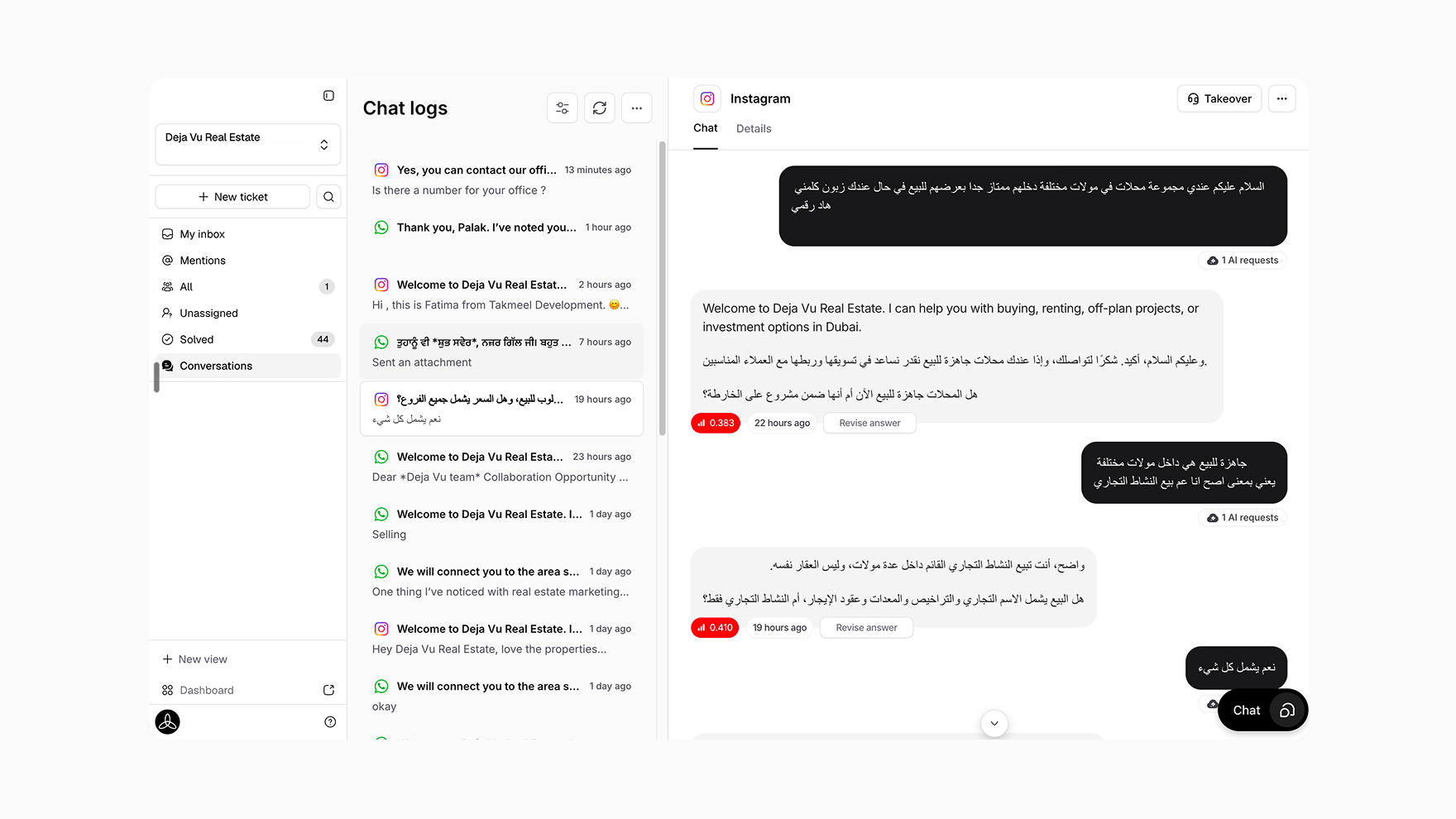
They can monitor customer interactions through a central backend dashboard, filter conversations by channel, understand what customers are asking and manage enquiries much more efficiently.
Instead of constantly jumping between platforms, the team gets one place to understand what is actually happening across their customer conversations.
AI when it works. Humans when they are needed.
I don't believe the goal of AI should be to remove humans from customer service.
The goal should be to make sure humans spend their time where they actually add value.
The AI agent can handle repetitive questions, provide immediate information and manage initial conversations. But the moment a customer wants to speak with a person, or the AI isn't confident about how to respond, the conversation can be escalated.
A ticket can be assigned to the appropriate team member, and a live agent can enter the conversation.
The team can also monitor conversations and step in whenever they feel a human response would be better.
For me, this is what makes the system practical.
It isn't AI versus humans.
It is AI taking care of the repetitive work so humans can focus on conversations that actually need them.
And then there is lead outreach
The platform isn't limited to responding to incoming enquiries.
We also helped Deja Vu use their existing customer and qualified lead database more effectively.
Their team can send bulk communications to relevant groups of customers and potential leads when there is a new residential development, construction project or property opportunity they want to share.
This becomes particularly useful in a market like Dubai, where new projects are constantly entering the market and timing matters.
Instead of having valuable leads sitting quietly in an old database, the business can re-engage the right audience when there is something genuinely relevant to share.
What changes for the customer?
They don't have to know that there is an entire system working behind the conversation.
They simply ask a question.
And they get a response.
They aren't waiting hours for someone to notice an Instagram DM. They aren't wondering whether their WhatsApp enquiry has disappeared somewhere. And they don't have to fill out a website form and hope somebody eventually calls them back.
That simplicity is important.
Because from a customer's perspective, good technology shouldn't feel complicated.
It should simply make the experience easier.
What changes for the business?
This is where the impact becomes much bigger.
The team has fewer repetitive enquiries to manually answer. Conversations are easier to track. Leads are less likely to fall through the cracks. Human agents can focus on serious enquiries instead of repeatedly answering the same questions.
And management gets much better visibility into what customers are actually asking across channels.
Most importantly, the business can be responsive even when the team isn't sitting in front of WhatsApp or Instagram waiting for the next message.
Setting it up doesn't have to become another technology project
When businesses hear words like AI agent, automation, knowledge base and omnichannel customer engagement, the immediate assumption is often that implementation is going to be complicated.
It doesn't have to be.
Our role at Syntropy is to understand how the business currently works, identify the conversations that can be automated, build the AI knowledge base, connect the relevant customer channels and create a clear escalation path for the human team.
The technology should adapt to the business, not the other way around.
And once the foundation is created, the AI agent can continue learning as the business grows, new projects are introduced and customer questions change.
This is where I see AI becoming genuinely useful for businesses
There is a lot of conversation around AI right now.
But for me, the interesting question has never been, "How do we add AI to a business?"
It is:
"Where is the business losing time, customers or opportunities because something is still unnecessarily manual?"
For Deja Vu, one of those opportunities was customer communication.
By bringing Instagram, WhatsApp and website enquiries together, giving the AI its own business-specific knowledge, allowing humans to step in whenever necessary, and making it easier to reconnect with existing leads, we were able to create something that feels much more useful than simply adding another chatbot to a website.
It becomes part of how the business operates.
And I think that's where AI becomes really powerful.
Not when customers notice it.
But when the entire experience simply works better.
Shivani
Founder, Syntropy

Connect with us to explore your project's potential.



What If Your Real Estate Business Could Respond to Every Lead, Instantly?
September 8, 2026
How we helped Deja Vu Real Estate bring Instagram, WhatsApp and website enquiries into one seamless AI-powered platform, enabling faster responses, smarter lead management and effortless human handovers.
In real estate, a lead rarely waits.
Someone sees a property on Instagram and sends a DM. Someone else lands on your website and wants to know the price of a villa they just saw. Another person sends a WhatsApp message asking if a particular project is still available.
And they all expect a response. Preferably now.
For a real estate team, managing these conversations across multiple platforms can quickly become chaotic. Instagram is being handled by one person, WhatsApp by another, website enquiries are landing somewhere else, and somewhere in between, a genuinely interested buyer is still waiting for someone to respond.
This was exactly the kind of problem we wanted to solve for Deja Vu Real Estate.
At Syntropy, we helped Deja Vu create an AI-powered customer engagement system that brings their website, WhatsApp and Instagram conversations together into one seamless platform.
But the interesting part for me wasn't simply adding an AI chatbot.
It was about creating an AI agent that actually understands their business.
An AI agent with its own Deja Vu brain
One of the first things we did was build a dedicated knowledge base for Deja Vu.
The AI agent can learn from the information available on their website and the business information provided by their team, including their services, projects, frequently asked questions and other relevant details.
Instead of behaving like a generic chatbot, the idea was to create something closer to a digital brand ambassador for the business.
So when someone asks a question, the agent isn't simply giving a predefined automated response. It uses Deja Vu's own business knowledge to understand the enquiry and respond appropriately.
And as the business evolves, that knowledge can evolve too.
Instagram, WhatsApp and website conversations in one place
This is probably one of my favourite parts of the solution.
A customer could discover Deja Vu on Instagram today, message them on WhatsApp tomorrow, or enquire through the website.
For the internal team, these conversations no longer need to feel like three completely disconnected worlds.
They can monitor customer interactions through a central backend dashboard, filter conversations by channel, understand what customers are asking and manage enquiries much more efficiently.
Instead of constantly jumping between platforms, the team gets one place to understand what is actually happening across their customer conversations.
AI when it works. Humans when they are needed.
I don't believe the goal of AI should be to remove humans from customer service.
The goal should be to make sure humans spend their time where they actually add value.
The AI agent can handle repetitive questions, provide immediate information and manage initial conversations. But the moment a customer wants to speak with a person, or the AI isn't confident about how to respond, the conversation can be escalated.
A ticket can be assigned to the appropriate team member, and a live agent can enter the conversation.
The team can also monitor conversations and step in whenever they feel a human response would be better.
For me, this is what makes the system practical.
It isn't AI versus humans.
It is AI taking care of the repetitive work so humans can focus on conversations that actually need them.
And then there is lead outreach
The platform isn't limited to responding to incoming enquiries.
We also helped Deja Vu use their existing customer and qualified lead database more effectively.
Their team can send bulk communications to relevant groups of customers and potential leads when there is a new residential development, construction project or property opportunity they want to share.
This becomes particularly useful in a market like Dubai, where new projects are constantly entering the market and timing matters.
Instead of having valuable leads sitting quietly in an old database, the business can re-engage the right audience when there is something genuinely relevant to share.
What changes for the customer?
They don't have to know that there is an entire system working behind the conversation.
They simply ask a question.
And they get a response.
They aren't waiting hours for someone to notice an Instagram DM. They aren't wondering whether their WhatsApp enquiry has disappeared somewhere. And they don't have to fill out a website form and hope somebody eventually calls them back.
That simplicity is important.
Because from a customer's perspective, good technology shouldn't feel complicated.
It should simply make the experience easier.
What changes for the business?
This is where the impact becomes much bigger.
The team has fewer repetitive enquiries to manually answer. Conversations are easier to track. Leads are less likely to fall through the cracks. Human agents can focus on serious enquiries instead of repeatedly answering the same questions.
And management gets much better visibility into what customers are actually asking across channels.
Most importantly, the business can be responsive even when the team isn't sitting in front of WhatsApp or Instagram waiting for the next message.
Setting it up doesn't have to become another technology project
When businesses hear words like AI agent, automation, knowledge base and omnichannel customer engagement, the immediate assumption is often that implementation is going to be complicated.
It doesn't have to be.
Our role at Syntropy is to understand how the business currently works, identify the conversations that can be automated, build the AI knowledge base, connect the relevant customer channels and create a clear escalation path for the human team.
The technology should adapt to the business, not the other way around.
And once the foundation is created, the AI agent can continue learning as the business grows, new projects are introduced and customer questions change.
This is where I see AI becoming genuinely useful for businesses
There is a lot of conversation around AI right now.
But for me, the interesting question has never been, "How do we add AI to a business?"
It is:
"Where is the business losing time, customers or opportunities because something is still unnecessarily manual?"
For Deja Vu, one of those opportunities was customer communication.
By bringing Instagram, WhatsApp and website enquiries together, giving the AI its own business-specific knowledge, allowing humans to step in whenever necessary, and making it easier to reconnect with existing leads, we were able to create something that feels much more useful than simply adding another chatbot to a website.
It becomes part of how the business operates.
And I think that's where AI becomes really powerful.
Not when customers notice it.
But when the entire experience simply works better.
Shivani
Founder, Syntropy

Connect with us to explore your project's potential.


What If Your Real Estate Business Could Respond to Every Lead, Instantly?
September 8, 2026
How we helped Deja Vu Real Estate bring Instagram, WhatsApp and website enquiries into one seamless AI-powered platform, enabling faster responses, smarter lead management and effortless human handovers.
In real estate, a lead rarely waits.
Someone sees a property on Instagram and sends a DM. Someone else lands on your website and wants to know the price of a villa they just saw. Another person sends a WhatsApp message asking if a particular project is still available.
And they all expect a response. Preferably now.
For a real estate team, managing these conversations across multiple platforms can quickly become chaotic. Instagram is being handled by one person, WhatsApp by another, website enquiries are landing somewhere else, and somewhere in between, a genuinely interested buyer is still waiting for someone to respond.
This was exactly the kind of problem we wanted to solve for Deja Vu Real Estate.
At Syntropy, we helped Deja Vu create an AI-powered customer engagement system that brings their website, WhatsApp and Instagram conversations together into one seamless platform.
But the interesting part for me wasn't simply adding an AI chatbot.
It was about creating an AI agent that actually understands their business.
An AI agent with its own Deja Vu brain
One of the first things we did was build a dedicated knowledge base for Deja Vu.
The AI agent can learn from the information available on their website and the business information provided by their team, including their services, projects, frequently asked questions and other relevant details.
Instead of behaving like a generic chatbot, the idea was to create something closer to a digital brand ambassador for the business.
So when someone asks a question, the agent isn't simply giving a predefined automated response. It uses Deja Vu's own business knowledge to understand the enquiry and respond appropriately.
And as the business evolves, that knowledge can evolve too.
Instagram, WhatsApp and website conversations in one place
This is probably one of my favourite parts of the solution.
A customer could discover Deja Vu on Instagram today, message them on WhatsApp tomorrow, or enquire through the website.
For the internal team, these conversations no longer need to feel like three completely disconnected worlds.
They can monitor customer interactions through a central backend dashboard, filter conversations by channel, understand what customers are asking and manage enquiries much more efficiently.
Instead of constantly jumping between platforms, the team gets one place to understand what is actually happening across their customer conversations.
AI when it works. Humans when they are needed.
I don't believe the goal of AI should be to remove humans from customer service.
The goal should be to make sure humans spend their time where they actually add value.
The AI agent can handle repetitive questions, provide immediate information and manage initial conversations. But the moment a customer wants to speak with a person, or the AI isn't confident about how to respond, the conversation can be escalated.
A ticket can be assigned to the appropriate team member, and a live agent can enter the conversation.
The team can also monitor conversations and step in whenever they feel a human response would be better.
For me, this is what makes the system practical.
It isn't AI versus humans.
It is AI taking care of the repetitive work so humans can focus on conversations that actually need them.
And then there is lead outreach
The platform isn't limited to responding to incoming enquiries.
We also helped Deja Vu use their existing customer and qualified lead database more effectively.
Their team can send bulk communications to relevant groups of customers and potential leads when there is a new residential development, construction project or property opportunity they want to share.
This becomes particularly useful in a market like Dubai, where new projects are constantly entering the market and timing matters.
Instead of having valuable leads sitting quietly in an old database, the business can re-engage the right audience when there is something genuinely relevant to share.
What changes for the customer?
They don't have to know that there is an entire system working behind the conversation.
They simply ask a question.
And they get a response.
They aren't waiting hours for someone to notice an Instagram DM. They aren't wondering whether their WhatsApp enquiry has disappeared somewhere. And they don't have to fill out a website form and hope somebody eventually calls them back.
That simplicity is important.
Because from a customer's perspective, good technology shouldn't feel complicated.
It should simply make the experience easier.
What changes for the business?
This is where the impact becomes much bigger.
The team has fewer repetitive enquiries to manually answer. Conversations are easier to track. Leads are less likely to fall through the cracks. Human agents can focus on serious enquiries instead of repeatedly answering the same questions.
And management gets much better visibility into what customers are actually asking across channels.
Most importantly, the business can be responsive even when the team isn't sitting in front of WhatsApp or Instagram waiting for the next message.
Setting it up doesn't have to become another technology project
When businesses hear words like AI agent, automation, knowledge base and omnichannel customer engagement, the immediate assumption is often that implementation is going to be complicated.
It doesn't have to be.
Our role at Syntropy is to understand how the business currently works, identify the conversations that can be automated, build the AI knowledge base, connect the relevant customer channels and create a clear escalation path for the human team.
The technology should adapt to the business, not the other way around.
And once the foundation is created, the AI agent can continue learning as the business grows, new projects are introduced and customer questions change.
This is where I see AI becoming genuinely useful for businesses
There is a lot of conversation around AI right now.
But for me, the interesting question has never been, "How do we add AI to a business?"
It is:
"Where is the business losing time, customers or opportunities because something is still unnecessarily manual?"
For Deja Vu, one of those opportunities was customer communication.
By bringing Instagram, WhatsApp and website enquiries together, giving the AI its own business-specific knowledge, allowing humans to step in whenever necessary, and making it easier to reconnect with existing leads, we were able to create something that feels much more useful than simply adding another chatbot to a website.
It becomes part of how the business operates.
And I think that's where AI becomes really powerful.
Not when customers notice it.
But when the entire experience simply works better.
Shivani
Founder, Syntropy

Connect with us to explore your project's potential.

